
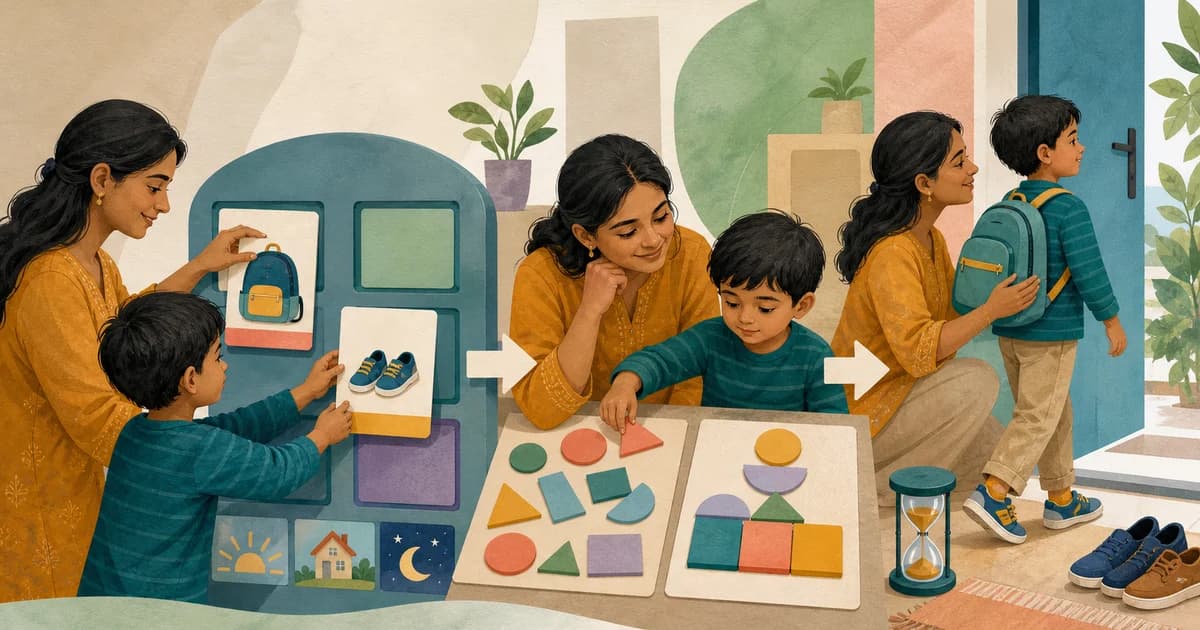
If your child insists on the “right” colour cup, forgets a two-step instruction, or struggles to stop playing for dinner, you may be seeing skills that are still developing, not a character flaw and not a diagnosis.
Everyday routines can create low-pressure chances to practise remembering, pausing, switching plans, and getting started. You do not need a complicated behaviour chart or a perfectly organised day.
What Are Executive Function Skills?
Executive function is an umbrella term that includes working memory, cognitive flexibility, and inhibitory control. In everyday language, those skills help us hold information in mind, adjust when a plan changes, and pause before acting.
These abilities develop over time and vary with age, sleep, hunger, stress, environment, and the demands of the task. The Center on the Developing Child at Harvard University offers age-based activities for practising them through play and routine.
Five Small Routines to Try
Choose one idea that fits a real friction point. Keep it simple enough to repeat, and change it if it creates more stress than it solves.
1. Start the Day with a Predictable Cue
A consistent cue, a song, opening the curtains, or moving one picture on a visual plan, can make the start of a routine easier to recognise.
For a younger child, show one action at a time: “First clothes, then breakfast.” For an older child, invite them to make a short two- or three-step checklist. Nurturevia’s First–Then Board can make one immediate sequence visible without creating an account.
2. Use Play to Practice Flexibility
Games that involve taking turns, switching roles, or changing one rule offer a playful way to practise flexibility. Try “Simon Says,” then let the child become the caller, or sort objects by colour and then by shape.
Keep the challenge adjustable. If changing the rule causes frustration, return to the familiar version and announce the change more clearly next time.
3. Name and Normalise Feelings
Feeling words can give a family more precise language than “good” or “bad.” Naming a feeling does not automatically change it, and a child should not be pressured to disclose.
Try Nurturevia’s optional Check In, or draw three faces on paper and ask, “Is any one of these close?” The activity does not score or interpret the answer.
4. Build in Micro-Transitions
Instead of an abrupt “stop now,” show what is ending and what comes next. A song, a sand timer, or a visual Transition Countdown can make time more concrete.
For preschoolers, keep the next action visible and specific: shoes by the door. For school-age children, agree on what “finished” means before play begins: this round, this page, or when the timer ends.
5. Celebrate the Try, Not Just the Win
Use specific acknowledgement instead of a large judgment: “You tried a second plan when the first one did not work,” or “You stopped when the timer ended.” The goal is to notice the strategy, not to demand persistence through distress.
When the Routine Does Not Work
A visual cue is not a command that makes every transition easy. Check the basics first: Is the child tired, hungry, in pain, overwhelmed by noise, or being asked to do too many steps? Can you reduce the demand, offer two acceptable choices, or practise at a calmer time?
If the same difficulty is intense, persistent, unsafe, or interfering with daily life, discuss the pattern with your child’s paediatrician or another qualified professional. Bring concrete observations, when it happens, what came before, what helped, rather than treating a game score or checklist as an assessment.
Start With One Routine
You do not need to overhaul your parenting or schedule. Pick one cue, use it consistently enough to learn whether it helps, and adjust it with your child when you can.
These ideas offer everyday practice, not a treatment plan or proof that a child’s executive-function skills have changed.